Reviving a dormant subscription feature
A subscription feature sat dormant at fewer than 1 in 16 orders. I ran the research and redesign that took it past 1 in 5.
Product Designer — Patient Experience · January 2021 – December 2022
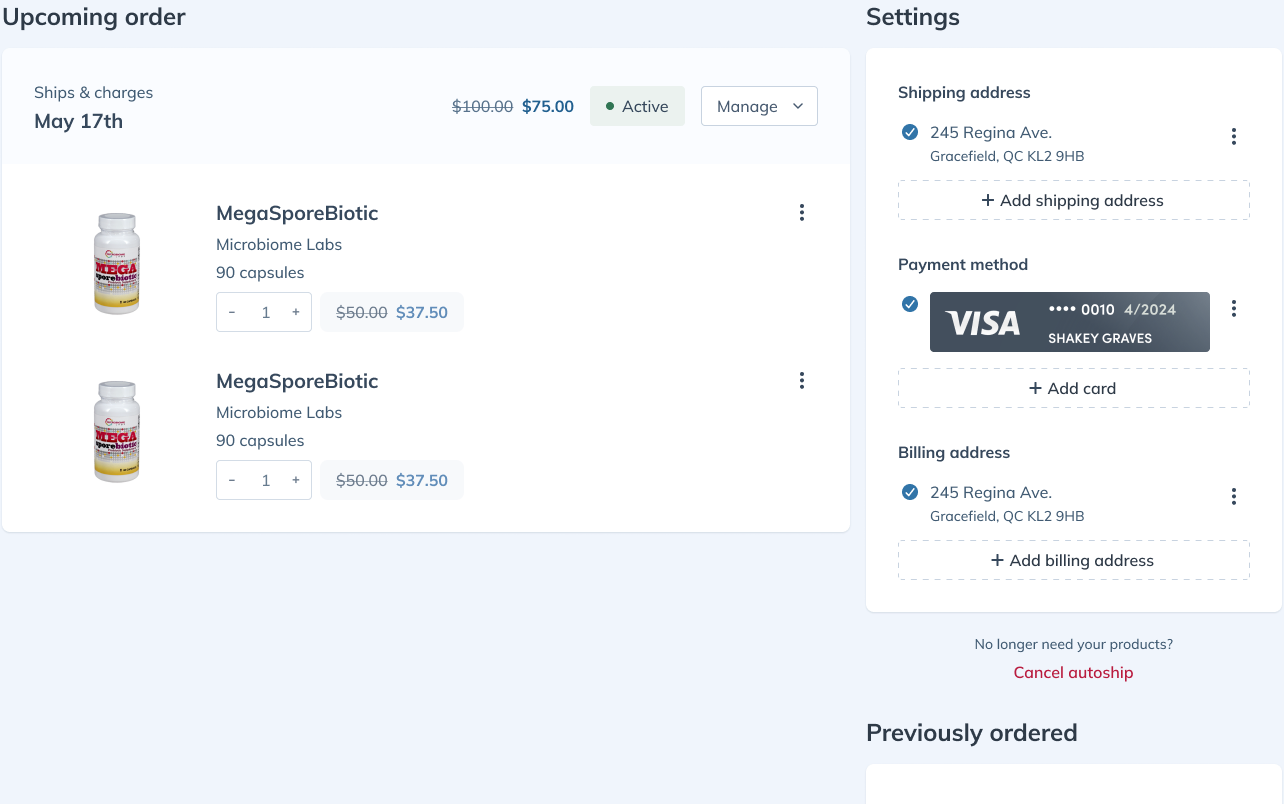
Patients prescribed the same supplements every month were reordering by hand — the subscription feature had existed since 2018, and fewer than 1 in 16 orders used it.
I started with a 1,485-response patient survey and a scored audit of every existing flow, then moved subscribing into the cart and rebuilt management around the control patients said they wanted.
Subscriptions went from fewer than 1 in 16 orders to more than 1 in 5, and the cancellation data is still setting the retention roadmap 4 years on.
Nothing on fire
Fullscript's revenue is practitioner-prescribed supplements, and most prescriptions run for months — but reordering was manual. The subscription feature that should have carried repeat revenue had sat dormant since 2018 at single-digit adoption. Nothing about it was on fire, so nothing about it got prioritized.
An hour on the phones
I sat in on customer support calls in my first months — 4 patient calls in a single hour, none about checkout mechanics. The friction was hesitation: refill timing, ending up with excess supplements, recurring charges you'd forget about. Those calls set the research agenda before I touched a screen.
1,485 patients answered
A card on the Autoship page plus an email drew 1,485 survey responses, and the result surprised everyone: 78% of existing users rated the feature 4 or 5 out of 5, while 13% of respondents didn't know it existed. Adoption, not quality, was the problem. The write-ins listed the exact controls patients were missing — skip, pause, deliver one now.
Grading every flow, step by step
To give the redesign something concrete to beat, I graded every existing flow step by step — the team took to calling it the rainbow spreadsheet. Survey plus audit convinced product and engineering to bet a full roadmap on a feature nobody had prioritized. That quarter became the busiest in Autoship's history.
Into the cart
Autoship sat off to the side of how patients order: browse, select, check out. A dedicated subscription page was the safe option and the invisible one, so I put the choice inside the cart, where the intent to buy already is. Everyone wants a piece of the cart, and risking every order to help one program was the scary part — we wrote the risk into the hypothesis and agreed on A/B guardrails before shipping anything.
Making leaving easy
Retention orthodoxy says make leaving hard. The survey said the opposite — patients asked, in their own words, to skip, pause without losing settings, and delay a shipment. We treated those write-ins as transcription rather than feature ideas: skip, reschedule, and frequency change shipped with the same prominence as cancel, betting that timing problems, not lost value, drove churn.
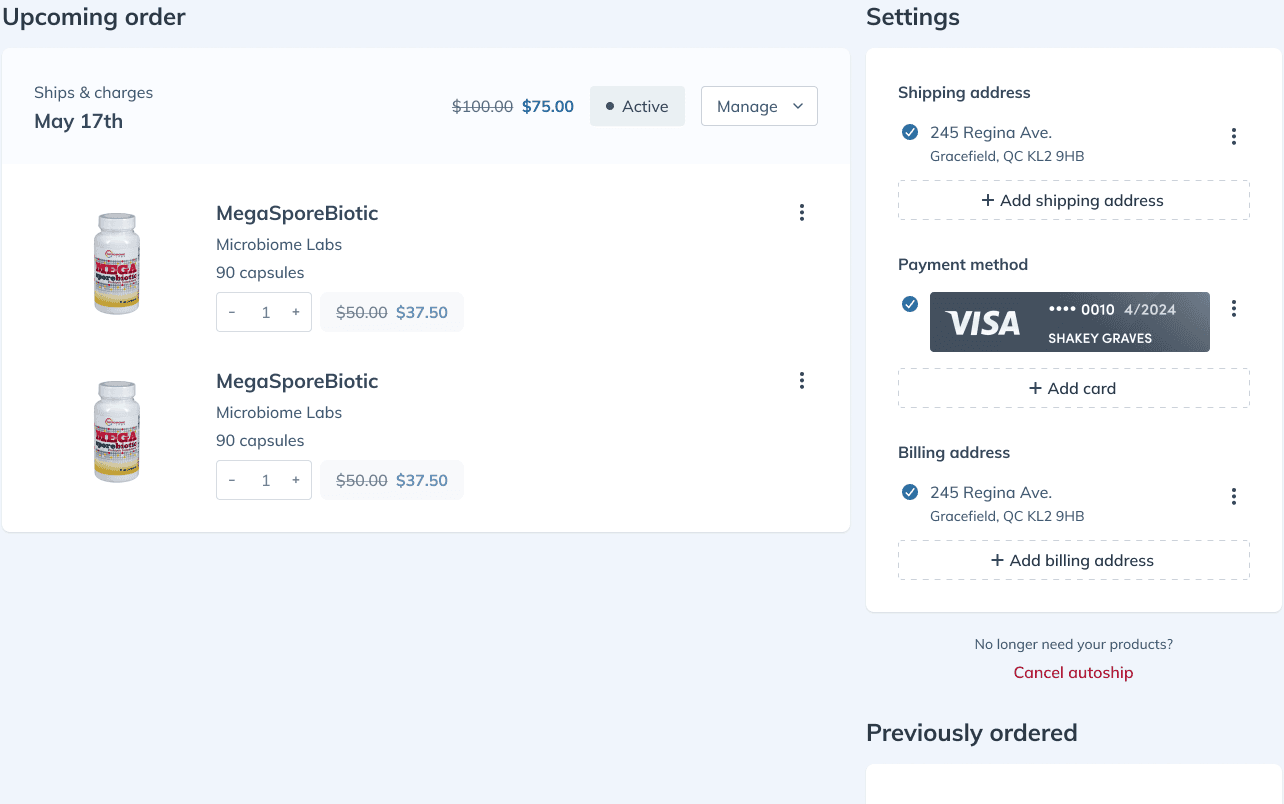
The Manage Autoship portal — skip, reschedule, and frequency controls carry the same weight as cancel, the flexibility patients asked for by name One question before cancelling
Adding a step to the most sensitive moment in the lifecycle reads as hostility, and dark-pattern cancel flows poison trust in a healthcare product. But a patient leaving silently teaches the team nothing. The compromise was one tap: cancelling asks why, once, with 3 honest plain-language reasons — enough supply, cost, or a product issue.
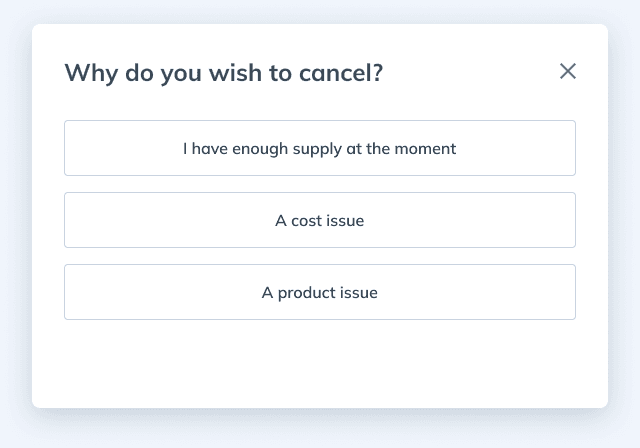
One tap, 3 honest reasons — the taxonomy has since grown to 9 and still feeds the retention roadmap 4 years later Three releases, April to September
In April 2022 the subscription choice moved inside both cart variants; in July came the Manage Autoship portal, with order now, skip, reschedule, and the cancellation dialog; in September, frequencies before checkout. By November, new subscriptions ran at 6.4 times January's volume.
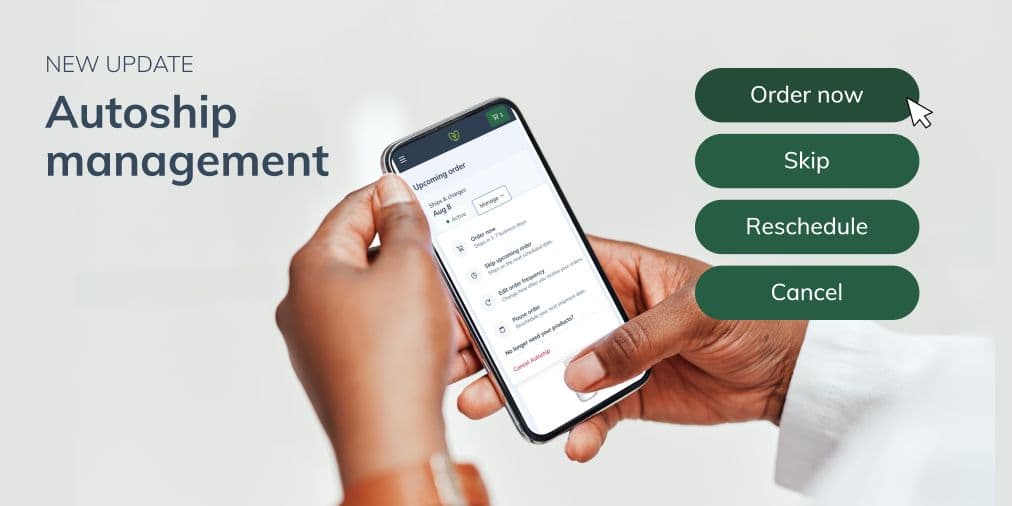
Fullscript's July 2022 launch announcement called these "three highly-requested features" — the survey wish-list, in the company's own voice Outcomes and impact
1 in 5Orders on subscriptionup from 1 in 16 in January 2021
6.4×New subscriptions, 2022
January to November 2022.
Six months after I rolled off, the data team put a number on why the company kept investing: patients who had ever activated Autoship placed a second order about 94% of the time, against roughly 55% for patients who never had. Activators are self-selected, so that's not all the redesign's doing — but it's the finding that kept Autoship on the roadmap.
Why patients cancel
Four years of cancellation data backed the bet: the reasons still cluster on timing, and skips and reschedules now happen about as often as cancellations. But the platform's top stated reason today is that patients cancel to merge two subscriptions onto one cadence — there's still no merge action, so they cancel to change, and roughly seven in ten never come back. The verb the taxonomy has been asking for since 2022 is one I didn't think to build.
The default I never questioned
Moving the choice into the cart worked, and it put weight on the cadence sitting pre-selected beside it. Every 30 days is still the most common cadence patients land on, and the platform's numbers now make it the worst-performing one — a 30-capsule bottle doesn't last 30 days. I shipped a default without doing that arithmetic.
It kept shipping without me
Harry Verran spent 2023 building the rest of the survey's wish-list: never-ordered products became eligible, practitioner-funded discounts landed, frequencies went from 8 down to 3. Discounts were the survey's biggest ask, and the company's own cohort numbers later backed it up. 1,485 responses bought a year of roadmap I didn't have to be there for.
Dormant features hide the biggest wins
Nothing about Autoship was on fire, which is exactly why nobody had looked closely at it. And the most durable thing I shipped that year was a screen most patients see exactly once: the cancellation dialog started collecting reasons in June 2022 and it still sets the retention roadmap.